I am going to be doing 'The four stages of day to night' photography. I was inspired by an artist called Stephen Wilkes as he does a time lapse over 15 hours to capture early morning and late night. His pictures are mostly set in busy places e.g New York's union square or central park, this made me think as I cannot travel far to busy places like this I should go to the center of York and take photographs here.
Day and night don't only show the difference visually but it also changes the mental thoughts towards the image for an example night time can make a person feel nervous because there is a lot of unknown and they are not fully aware of what's going on. The difference between day and night in my photographs is that you can see everything within the day time so we are all fully aware of what is going where as in the night time photograph even though it will still be the same photograph of the day photo it is darker so we cannot see everything therefore we are not aware of what is going on. This is how the emotions change towards the pictures. This is the difference between day and night.
As doing a time lapse would take so long and I would only get one full picture out of my final piece I thought I would take four pictures of the same subject over four most important times of the day e.g early morning (7am), Midday (12pm), sunset (4pm) and night time (8pm). I will then use Photoshop to include the four photos into one full picture. I will repeat this process 11 more times but my subject will be a different place each time e.g the York minster, the Shambles etc.
I will produce all my photos over two days so I have more time to chose which are my better pictures, upload them to Photoshop and edit them together. My idea is to create a book and an online gallery to present my photographs. My book and online gallery will consume of 12 photographs I have taken and edited together. I may include a time lapse over a few hours in a day if it all goes to plan, if not i will still include some thumbnail photographs I have taken to prove I tried to make a time lapse.
Thursday, 21 November 2013

Wednesday, 13 November 2013

Wednesday, 23 October 2013
Geometry - Henri Cartier Bresson

Through his keen sensibility, understanding of composition and appreciation for the moment, Henri Cartier-Bresson established his name as one of the greatest photographers of the 20th century. Despite his recognition as such, he did not see himself primarily as a photographer, but as an active participant in the unfolding of history.
Henri used shapes in his photographs to make them more interesting for the viewers and his theory worked as he became famous for it and one of the greatest photographers.
Acheivements - Robert Frank
 We researched about a man named Robert Frank as he is a photographer and looked at a certain subject he did which was achievements so we went out and took a few of our own. Robert Frank (born November 9, 1924) is an important figure in American photography and film. His most notable work, the 1958 book titled The Americans, was influential, and earned Frank comparisons to a modern-day de Tocqueville
for his fresh and nuanced outsider's view of American society.
We researched about a man named Robert Frank as he is a photographer and looked at a certain subject he did which was achievements so we went out and took a few of our own. Robert Frank (born November 9, 1924) is an important figure in American photography and film. His most notable work, the 1958 book titled The Americans, was influential, and earned Frank comparisons to a modern-day de Tocqueville
for his fresh and nuanced outsider's view of American society.
experimented with manipulating photographs
and photo montage.
Here are three pictures, the top two are about a boy who couldn't tie his shoe laces but in the end successfully did so we took a picture of his achievement. The last photo is about a lyric I couldn't sing and as we couldn't photograph this I looked excited because I finally sang the lyric correctly.
 Achievements is a good idea to take pictures of. It captures the moment and as you or a friend has done something brilliant or just something small that means a lot to them you can always look back at that picture and see how happy or proud they were and how it makes someone feel in the present day remembering that memory.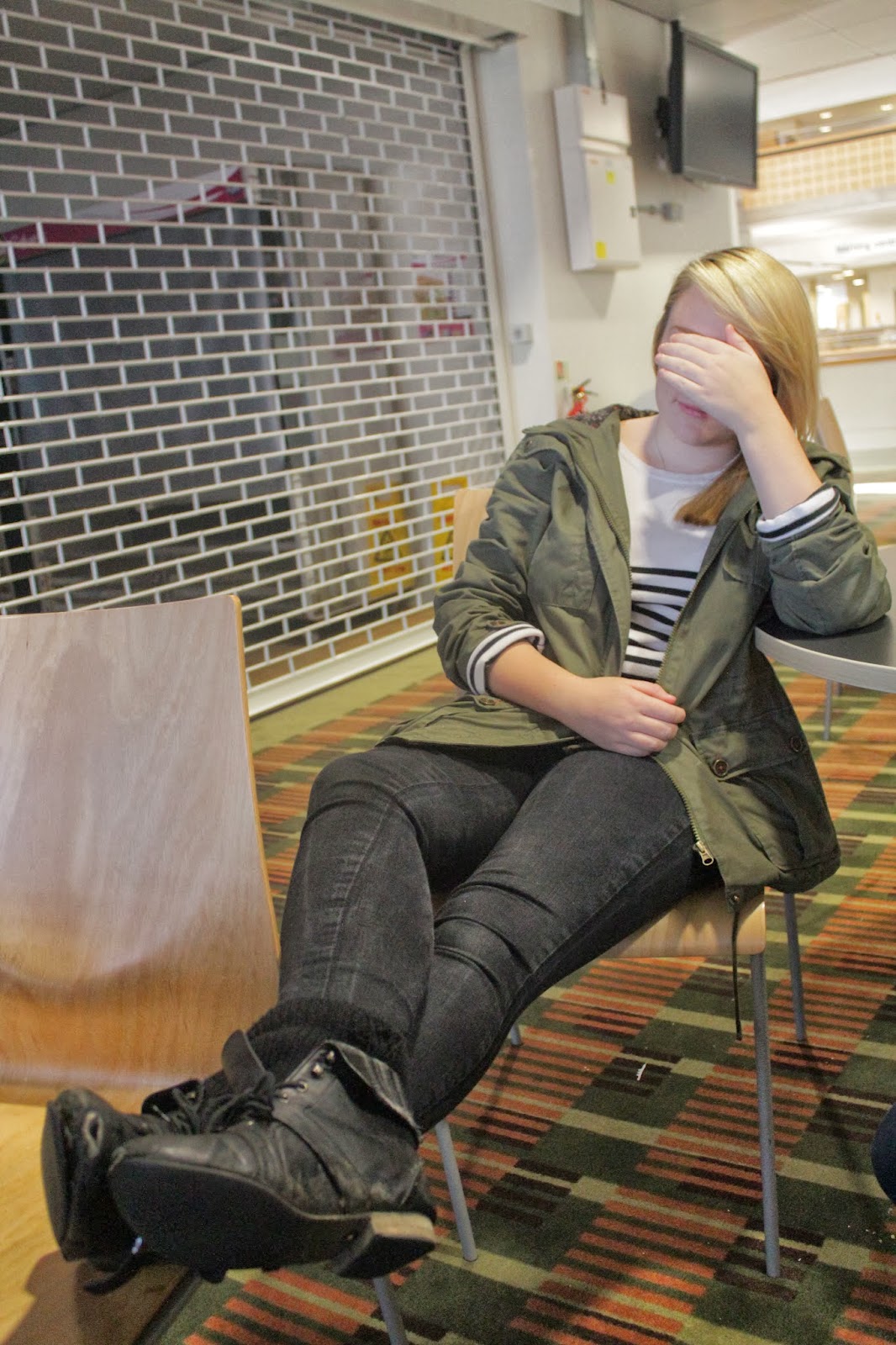


Thursday, 17 October 2013
Reflection, Repetition, Shadows and Yourself - Friedlander
Reflection
 This photograph shows reflection which was captured in a glass window inside college.The picture itself is rather blurred but you can still make out two people are stood in front of the glass taking a picture of their reflection. When a shot of a reflection is taken either it just been a picture or in a movie the idea is that the person who we can see in the reflection are thinking about themselves and their life. It's kind of like looking in to the mind of someone visually from the outside so we have an idea of what they are thinking about.
The photograph here shows reflection outside on a sunny day of the person taking to photo (me) and a friend. We are separated by a bar which I tried to use as a form of framing. This picture also uses a slight form of repetition as my friend is captured in the reflection but also seen in the background of a door behind us. The idea here of my friend captured in two reflections could mean a couple of things e,g, she may have two personalities, the one showing who she really is is the clear reflection in the window and the reflection taking in the door behind could show that this is her other personality, mysterious and dark as her back is turned so we do not know who she really is.It could also mean she is reflecting on her life in to so much depth that she has split herself in to two e.g the bad things she's done and the good things she's done.
Repetition


These pictures were taken outside the college in a bike shelter, as many people cycle to college and all the bikes get locked up here we thought it would be a brilliant place to take a picture for repetition as bikes look almost the same. The idea of repetition is to show the subject of 'same' if it were a picture of people it would show them all lined up and how similar human are but on the other hand in this picture the bikes are a different colour, different sized wheels and different makes of the bikes. Therefor although it shows how similar the item/person is in the picture it also shows that everything is individual and unique at the same time due to small changes.
I saw this was a good choice of repetition as i was only walking down the stairs and just decided to look all the way down to find that it's sort of a spiral stair case and it gets smaller the further down it gets therefore the camera could capture each banister. This shows repetition in a way but not much of it. as the picture was taken leaning over the left hand side of the stairs we can only really see the right hand stair case going all the way down and it doesn't last that long. It only really shows three stair cases and in a way they all look the same but the lighting on all different floors makes them look different a little bit.
Shadows and Ourselves

 This day was a really sunny day which was perfect as we were taking pictures of shadows. We were also taking pictures of ourselves so we decided to incorporate both ideas and not only take pictures of things with shadows but of our shadows therefore two subjects are in the same picture. We were looking at and artist called Diane Arbus who takes pictures of people for her subject. She doesn't just take pictures of everyday people though, she focuses on the abnormal as she would say. She takes pictures of people who are poor and cannot handle much or are homeless, who do not really have purpose in life. We found the top left picture looked fascinating as the sign made writing on the ground but the picture below is of a person. I had the idea from Diane Arbus as she focused on the abnormal and as my friend has her back turned this again could show she is mysterious or dark and mean due to her shadow that is straight in front of her.
Monday, 14 October 2013
taking photos of people - Diane Arbus

 I researched about Diane Arbus and her subject in photography is to take pictures of people but not the normal daily life like I have done as you can see in these pictures. Diane took pictures of people of people she thought were different from the norm. Diane was an American photographer and writer noted for black-and-white square photographs of "deviant and marginal people (dwarfs, giants, transgender people, nudists, circus performers) or of people whose normality seems ugly or surreal".Arbus believed that a camera could be "a little bit cold, a little bit

 harsh" but its scrutiny revealed the truth; the difference between what
people wanted others to see and what they really did see – the flaws. A friend said that Arbus said that she was "afraid ... that she would be known simply as 'the photographer of freaks'";
harsh" but its scrutiny revealed the truth; the difference between what
people wanted others to see and what they really did see – the flaws. A friend said that Arbus said that she was "afraid ... that she would be known simply as 'the photographer of freaks'";
however, that phrase has been used
repeatedly to describe her.
Exposure triangles
The three elements of the exposure triangle are -
ISO - the measure of a digital camera sensor’s sensitivity to light
Aperture - the size of the opening in the lens when a picture is taken
Shutter speed - the amount of time that the shutter is open
The exposure can be found either looking through the lens or in the information.
+2 means that the image will be over exposed (too dark). -2 means the image will be underexposed (too bright).
ISO - the measure of a digital camera sensor’s sensitivity to light
Aperture - the size of the opening in the lens when a picture is taken
Shutter speed - the amount of time that the shutter is open
The exposure can be found either looking through the lens or in the information.
+2 means that the image will be over exposed (too dark). -2 means the image will be underexposed (too bright).
It is at the intersection of these three elements that an image’s exposure is worked out.
Most importantly – a change in one of the elements will impact the others. This means that you can never really isolate just one of the elements alone but always need to have the others in the back of your mind.
METAPHORS OF REMEMBERING ALL THE ELEMENTS.
THE WINDOW
Imagine your camera is like a window with shutters that open and close.
Aperture is the size of the window. If it’s bigger more light gets through and the room is brighter.
Shutter Speed is the amount of time that the shutters of the window are open. The longer you leave them open the more that comes in.
Now imagine that you’re inside the room and are wearing sunglasses (hopefully this isn’t too much of a stretch). Your eyes become desensitized to the light that comes in (it’s like a low ISO).
There are a number of ways of increasing the amount of light in the room (or at least how much it seems that there is. You could increase the time that the shutters are open (decrease shutter speed), you could increase the size of the window (increase aperture) or you could take off your sunglasses (make the ISO larger).
changing aperture changes depth of field, changing ISO changes the graininess of a shot and changing shutter speed impacts how motion is captured.
Subscribe to:
Posts (Atom)